Postulate - 1
Postulate-1
The ultimate definition and the behavior of the real are embedded in randomly organized structural entities(ROSE) which can only be understood by their topological behaviors independent of the physical laws. Even though nature is Physics, and is the ultimate domain of constraint of these entities making certain localizations possible to observe and deduce, however, it seems to be that the real is manifested in a way that can be describable with a certain knowledge of topology hidden inside the irrational ratios of nature. Even what we call calculus, numerical and analytical actions can be described with entirely different ways of expression, not just expression but a series of topological actions.
Bizarre enlightenment came to me as one of the clearest
examples of this;
Inside a eucaryote cell, the endoplasmic reticulum has a particular topological structure and mapping between the slabs of geometrically aligned planes and boundaries. This microtubule structure stability can only be understood via their topological indications - Weak electrostatic forces, attractive forces, dipole interactions, and other mechanical forces.
The same mapping is observable when we look at the inner
crust of neutron stars and the nuclear matter - nucleon-nucleon interactions, strong fields, nuclear
forces, and also the orbits of strangely self-tracking flight formation
calculations of classical orbital mechanics - mechanical and gravitational forces.
The solutions of most differential equations in relativistic quantum mechanics and particle physics point out a surface or any other topology which is similar to previous ones - electromagnetic forces, and weak interactions.
Even though the fundamental nature of the physical forces and the laws governing these situations are completely different, they are all confined to a certain constraint that can only be referable via their topological manifestations.
So, the solution spaces of minimal surfaces have a significant role in determining the relations between these topological and physical entities.
Nature has no secrets. She has mysteries thus it can be less
mysterious if you have the right tools.
Mysteries can be solved, and secrets can only be revealed which
is not possible in the case of a non-speaking, anti-logos environment.
-B.C.C.
.jpg)
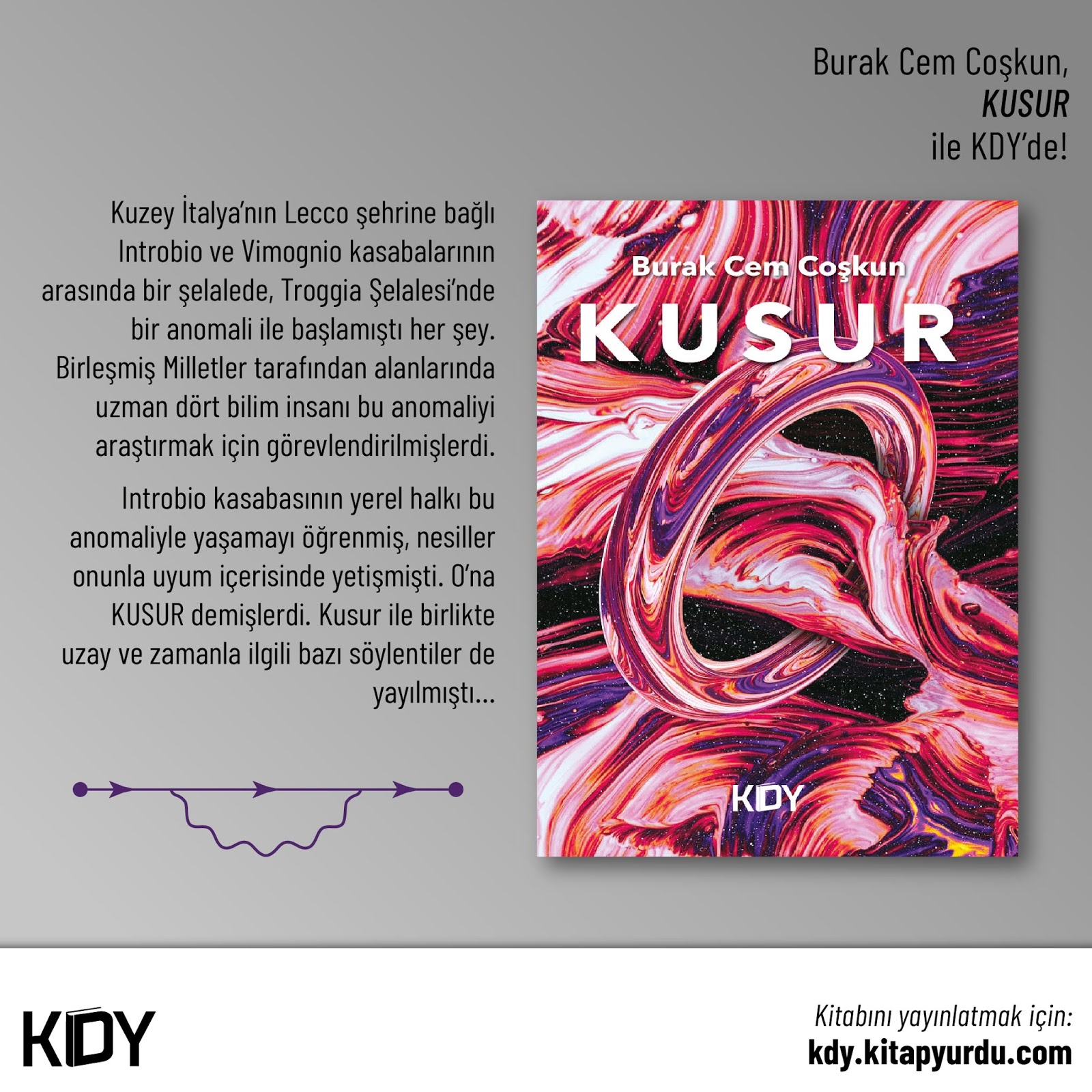
This is the main reason for my choice as a cover of the book KUSUR which is a Penrose drawing lookalike digital art based on the similar ideas mentioned in my postulate – 1.
.png)

Rastlantısal Olarak Örgütlenmiş Yapısal Varlıklar (ROSE): Teorik Fizik ve Biyofizik Kesişiminde Topolojik Bir Paradigma Analizi
1. Giriş: Fiziksel Yasaların Ötesinde Bir Gerçeklik Arayışı
Bilimsel araştırmaların çağdaş seyri, yerleşik metodolojilerin ve akademik dogmaların, gerçekliğin özsel doğasını kavramada epistemolojik birer engele dönüştüğünü ifşa etmektedir. Günümüzde "bilim" ile "bilimcilik" (scientism) arasındaki ayrım bulanıklaşmış; kurumlar, bilimselliğin özünden ziyade bürokratik süreçlerin ve PR odaklı sunumların tahakkümüne girmiştir. Mevcut fiziksel paradigma, "şeyleri" parçalara ayırıp tanımlama gayretiyle bütünü ıskalarken, Burak Cem Coşkun’un formüle ettiği ROSE (Randomly Organized Structural Entities - Rastlantısal Olarak Örgütlenmiş Yapısal Varlıklar) postulatı, gerçekliğin nihai tanımını fizik yasalarından bağımsız topolojik davranışlarda aramaktadır.
ROSE, rastlantısallığın nasıl olup da örgütlü bir topolojik kararlılığa ulaştığını açıklayan bir paradokstur. Bu perspektife göre doğa, bu varlıkların yerelleşmesini mümkün kılan kısıtlayıcı bir alan olsa da "gerçek", doğadaki irrasyonel oranların içine gömülmüş gizli bir topoloji bilgisinin manifestosudur. Geleneksel nedensellik bağlarının tıkandığı noktada, evrensel bir topolojik süreklilik devreye girerek gerçekliğin dokusunu yeniden dokur.
2. ROSE Postulatının Matematiksel ve Topolojik Temelleri
Diferansiyel geometri ve minimal yüzeylerin analitik çözüm uzayları, fiziksel kısıtlamaların ötesindeki ontolojik tutarlılığı (coherence) muhafaza eden yegâne unsurlardır. "Peki, ama neden?" sorusunun cevabı, fiziğin yerleşik yasalarının daha önce fark edilmemiş bir engelle karşılaştığı anlarda saklıdır: Matematik ve topoloji, yasaların bütünlüğünü ve tutarlılığını korumak için devreye girer. Bu bağlamda, kalkülüs artık basit bir sayısal işlem yığını değil, evrenin geometrik dışavurumu olan bir dizi "topolojik eylem" (topological actions) olarak yeniden tanımlanmalıdır.
Doğanın irrasyonel oranları, kaosun içindeki gizli düzenin geometrik bir manifestosudur. Sayısal işlemler, bu derin basitliği yüzeye çıkaran topolojik araçlardır.
- Çözüm Uzayları ve Minimal Yüzeyler: Topolojik ve fiziksel varlıklar arasındaki ilişkinin tayininde, fiziksel yasanın tıkandığı noktayı aşan bir süreklilik sağlar.
- Kendi Kendine Benzer Çözümler (Self-Similarity): Diferansiyel denklemlerin çözümünde, doğanın fraktal döngüselliğine en sadık ve en güçlü adaylar olarak tezahür ederler.
- Kalkülüsün Topolojik Eylem Olarak Yeniden Tanımı: Analitik işlemlerin, evrensel ahengin geometrik ifade biçimleri olarak kavranması; "hesaplama"dan "anlama"ya geçişi temsil eder.
3. Biyofizik ve Astrofizik Kesişimi: Endoplazmik Retikulum ve Nötron Yıldızları
Farklı fiziksel ölçekler arasındaki yapısal izomorfizm, ROSE postulatının öngördüğü topolojik egemenliğin en somut kanıtıdır. Ökaryot hücrelerdeki endoplazmik retikulum (ER) ile nötron yıldızlarının iç kabuğundaki nükleer madde arasındaki topolojik haritalama, evrenin mikroskobik ve makroskobik uçları arasındaki bir ahengi betimler. Burada kilit nokta, tamamen farklı temel kuvvetler (zayıf elektrostatik kuvvetler vs. güçlü nükleer kuvvetler) altında dahi aynı topolojik yüzeylerin ortaya çıkmasıdır.
Özellik | Biyolojik Sistemler (Endoplazmik Retikulum) | Astrofiziksel Sistemler (Nötron Yıldızları) |
Ölçek | Mikroskobik (Hücre İçi) | Makroskobik (Yıldız İç Kabuğu) |
Etkin Kuvvetler | Zayıf elektrostatik kuvvetler, dipol etkileşimleri, mekanik kuvvetler. | Nükleon-nükleon etkileşimleri, güçlü nükleer alanlar, kütleçekimi. |
Geometrik Kısıtlar | Microtubule structure stability (mikrotübül yapı kararlılığı). | Pasta-like (makarna benzeri) tabakalı nükleer madde. |
Topolojik Karakteristik | Geometrik hizalanmış düzlemler arası topolojik haritalama. | Self-tracking flight formations (kendi kendini takip eden uçuş formasyonları). |
Fiziksel yasalar ve kuvvetler farklı olsa da, her iki sistem de ancak topolojik tezahürleri (minimal yüzeyler) aracılığıyla referans verilebilecek evrensel bir kısıtlamaya tabidir. Bu durum, ROSE’un gerçekliğin temelindeki topolojik zarafetini doğrulamaktadır.
4. Metodolojik Başkaldırı: Mevcut Bilimsel Paradigmanın Eleştirisi
Bilim, doğası gereği anarşisttir ve Feynman’ın deyimiyle "uzmanların cehaletine duyulan güvendir." Ancak günümüz akademisi, bu anarşist ruhu "yöntemsel körelme" ve "statüko" ile boğmuştur. Akademik cemiyet, yeni teorileri rasyonelliklerinden ziyade yerleşik "estetik kaygılar" ve "tutarlılık şartı" (consistency condition) nedeniyle dışlamaktadır. Bu tutarlılık sevdası, aslında eski teorilerin hegemonyasını korumaktan başka bir işe yaramayan dogmatik bir zırhtır.
Bilimsel süreçteki bu yığılma (intellectual congestion) öyle bir noktaya gelmiştir ki, olağanüstü görünen çalışmaların yalnızca %10’u atıf alabilmekte, geri kalanı hiçliğe karışmaktadır. "Akademinin karanlık yüzü", Max Planck Enstitüleri (MPI) gibi saygın kurumlarda dahi belgelenen sistematik mobbing ve araştırmacıların fon mahkûmiyetine dönüşen köleliği ile kendisini göstermektedir. ROSE postulatı, bu metodolojik krizden çıkışın, "MACHO" (Yüksek Kütleli Kompakt Halo Objeleri) gibi dışlanan alternatifleri dahi kapsayabilen bir "şeyi gerçekten anlama" sanatına geri dönüşle mümkün olduğunu savunur.
5. Logos ve Mitosun Birleşimi: İyon Düşüncesinden Kozmik Örüntüye
Doğayı idrak etmek, teknik tanımların ötesinde bir "anlama sanatı" ve insanın doğaya kendi aklını giydirmesidir. Modern bilimin düştüğü dogmatik körlükten kurtuluş, antik İyon düşünürlerinin felsefi sağduyusunda gizlidir. Thales’in manyetizması, Anaksimandros’un apeironu ve Herakleitos’un Logosu (Ateş), evrensel ahengi temsil eden ilk büyük topolojik kavrayışlardır.
Herakleitos’un "Ateş/Logos" kavramı, ROSE postulatındaki topolojik dışavurumun arkaik ama temel formudur; o, fiziksel tezahürden önce gelen asli topolojik ifadedir. Bu bağlamda "Düşzamanı" (Dreamtime), sadece bir mitos değil, Conformal Cyclic Cosmology ve Cosmic Ouroboros (Kozmik Üroboros) analojilerinde karşılığını bulan bir evren algısıdır. "Düşler yaratır" önermesi, bilincin kuantum dalga fonksiyonlarının çöküşüne karşı gösterdiği bir direnç ve topolojik bir belirme olduğunu fısıldar. Gerçeklik, Borges’in yolları çatallanan bahçesinde, mitosun sezgisiyle Logos’un rasyonelliğinin kesiştiği noktadadır.
6. Sonuç: Yeni Sınırlar ve Vizyoner Gelecek
ROSE postulatı, bilimi uysal bir yöntemler manzumesi olmaktan çıkarıp, onu yeniden "evcilleştirilemez bir güç" haline getirme çağrısıdır. Robert Oppenheimer’ın bahsettiği "Kapitza’nın timsahı", bilimin durdurulamaz ve sürekli ileri giden doğasını temsil ederdi. Ancak bugün, metodolojik kısıtlamalar ve akademik statüko nedeniyle o timsah dişsiz ve cılız (emaciated) kalmış; yediklerini sindiremez hale gelmiştir.
Geleceğin bilimsel devrimi, bilimi politik anonsların ve bürokratik PR çalışmalarının boyunduruğundan kurtaracak olan "İyoncu rüya" ile başlayacaktır. Araştırma, seçkin bir zümrenin ayrıcalığı değil, evrensel bir keşif yolculuğudur. Gerçek, fiziksel parametrelerin ötesindeki topolojik zarafette ve doğanın kusurlu görünen tabiatının altındaki korunmuş simetride saklıdır. Bilim insanının görevi, Anadolu’nun gezgin dervişleri gibi tabiatın sınırlarında dolaşarak, kozmik örüntünün yeni sınırlarını tahayyül etmek ve bilim timsahını yeniden özgür bırakmaktır.
The ROSE Postulate: Bridging Topology, Biophysics, and Theoretical Astrophysics – A Methodological Manifesto
1. Abstract and Strategic Context
The contemporary scientific enterprise is suffocating under a "methodological stagnation." We have traded the visionary fire of the phusiologoi for a bureaucratic "check-list" culture and the sterile pursuit of status. To shatter this impasse, a strategic pivot is required: we must move from the dry cataloging of causal, law-dependent models toward a radical, topology-centric understanding of the manifold. The ROSE (Randomly Organized Structural Entities) postulate provides the mathematical and philosophical framework for this transition. It posits that "the real" is not defined by the fleeting specificities of physical forces, but by invariant topological behaviors and irrational ratios that persist across all scales—from the microscopic architecture of the cell to the crushing density of a neutron star. This manifesto serves as a bridge between the ancient mythos of cosmic patterns and the rigorous logos of a new, rebellious scientific inquiry.
Keywords
- Topological Expressivity: The fundamental capacity of geometric forms to represent the essence of reality, independent of whether the underlying force is electromagnetic, nuclear, or gravitational.
- Counter-Inductive Methodology: An essential tool for breaking methodological stagnation; it is the deliberate employment of hypotheses that contradict established laws to reveal deeper truths.
- Minimal Surface Solution Spaces: The ultimate mathematical domains of the real, where topological and physical entities intersect to preserve coherence when physical laws encounter unrecognized obstacles.
2. The Epistemological Crisis: Science vs. Scientism
We live in an age of "barren suffocation," where the directionless winds of post-truth discourse mask a deeper rot: the conflation of science with bureaucratic scientism. The modern intellectual class has taken a vow of silence, presiding over a system that prioritizes "checking" over discovering. This is the death of the Ionian Dream—the intellectual freedom of the ancient natural philosophers—replaced by the Wissenschaft des Rheins (the Science of the Rhine). This "science of the flow" is a zombified conformity I witnessed most clearly in the halls of Bonn; it is a movement that ignores the mental processes of discovery in favor of a mindless, forward-creeping status quo.
"Against an academic façade that once dismissed Richard Feynman as 'uncivilized' and 'lacking philosophical depth,' we must assert that his reward was the unveiling of true majesty. The bureaucrats who condemned him were blind to the deep simplicity of nature; they were trapped in aesthetic vanities, prioritizing elegant calculations over the visceral, messy truth of the cosmic tapestry."
To move forward, we must abandon the sociological congestion of modern academia—where 90% of breakthroughs dissolve into un-cited oblivion—and turn to the mathematical clarity of the ROSE framework.
3. The ROSE Postulate: Defining Randomly Organized Structural Entities
The ROSE Postulate (Postulate XXVII) stands as the ultimate definition of "the real." It asserts that reality is not a collection of parts governed by isolated forces, but a manifestation of irrational ratios and topological invariants. Whether we observe a galaxy or a protein, the geometry of reality remains consistent. Nature is the ultimate domain of constraint, but truth is a holographic projection of conserved, symmetric patterns.
The ROSE Framework vs. Traditional Modeling
Feature | Traditional Physical Modeling | The ROSE Framework |
Foundational Logic | Axiom + Model + Correspondence | Topological Manifestation + Minimal Surfaces |
Dependency | Tethered to specific force carriers | Invariant across all physical laws |
Nature of Inquiry | Dissection into rigid, mental blocks | Engagement with self-similar, living forms |
Validation | Compliance with institutional consensus | Discovery of "Profound Simplicity" in Solution Spaces |
4. Comparative Morphology: Endoplasmic Reticulum and Neutron Stars
The "bizarre enlightenment" that validates Postulate XXVII is found in the structural identity between the biological micro-cosmos and the astrophysical macro-cosmos. When we strip away the force carriers, the mapping is identical.
- The Endoplasmic Reticulum (ER): Within the eukaryote cell, the ER forms a specific topology of geometrically aligned planes and "slabs." Its microtubule structure stability is maintained by weak electrostatic forces and dipole interactions.
- The Inner Crust of Neutron Stars: In the ultra-dense environment of a neutron star, dominated by nucleon-nucleon interactions and strong nuclear fields, we find the exact same "slab-like" topological mapping.
The Invariant Solution Spaces
- Convergence of Differential Equations: Whether calculated via relativistic quantum mechanics or particle physics, the math points toward the same universal surfaces.
- Scale Independence: The topology remains invariant despite the transition from the weak forces of cellular biology to the gargantuan gravitational and nuclear forces of a star.
- Universal Constraints: As seen in the "self-tracking flight formation" calculations of classical orbital mechanics, nature utilizes the same geometric solutions for stability regardless of the material.
We must reject the narrow analytical limits of figures like von Neumann or Dirac when they serve to obscure these connections. A "topologically expressive understanding" demands we see the ER and the Neutron Star as the same topological manifestation.
5. The Anarchist Methodology: Counter-Induction as a Tool for Discovery
Science is inherently anarchistic. It is, as Feynman noted, the "belief in the ignorance of experts." The "Consistency Condition"—the dogmatic requirement that every new theory must align with established fossils like \LambdaCDM—is a shackle that kills diversity and restricts the freedom of the mind. It preserves the status of the old at the expense of the true.
Kapitza’s Crocodile: A Metaphor for Stagnation
Robert Oppenheimer spoke of the crocodile on Kapitza’s laboratory—a creature that cannot turn its head. It must move forward, devouring everything in its path. Today, that crocodile is:
- Toothless: It can no longer digest the information it devours.
- Emaciated: It is deprived of the "nourishing essence" of genuine inquiry.
- Sluggish: It crawls forward in a straight line, unable to pivot or look back at the wreckage of its own failed paradigms.
To restore the "nourishing essence" to science, we must embrace chaos. Knowledge without chaos is impossible. We must allow "fictions" and "passions" to lead us where the "voice of reason"—often just the voice of institutional training—cannot go.
6. Consciousness, "DREAMTIME," and the Unified Manifold
In the ROSE framework, consciousness is not a byproduct of matter; it is the resistance to collapse. It is the fundamental force that maintains the stability of the topological manifold.
The Aboriginal concept of "Dreamtime" is a sophisticated anthropological metaphor for Conformal Cyclic Cosmology (CCC) and the Cosmic Ouroboros. It describes a universe where "dreams create" and evolution is the transformation of thought into motion. This aligns perfectly with the Orch OR theory of Penrose and Hameroff. By viewing microtubule-based consciousness as a quantum system, we see that the boundary and connectivity surfaces of the cellular cytoskeleton are the very same topological solution spaces defined in Postulate XXVII.
The Collective LINK (the global network of consciousness) ensures that while individual memories may decay into "sub-nothingness," they leave behind topological traces. This "reincarnation of ideas" ensures the LINK itself is never harmed. In this transcendental state, the act of observing the grandeur of nature is not merely "watching"—it is the performance of physics.
7. Conclusion: Toward a New Phusiologos
The future of our species depends on reclaiming the Ionian legacy. We must return to the primal questions of Thales’ magnetism, Anaximenes’ breath, and Anaximander’s apeiron. The "curious phusiologos" must battle to nurture the dream of Blue Anatolia, moving beyond the "dark side of academia" and its hollow PR stunts.
The journey of the ROSE postulate began in the Nobel traditions of Stockholm's Oskar Klein Auditorium and continued through the existential walks along the banks of the Rhine in Bonn. Now, among the ancient olive trees of the Aegean, it calls for a union between the wandering dervishes of nature and the scientists of the new age. We must imagine the new boundaries of our cosmic pattern.
How Can Something Be Random and Organized at the Same Time?
Within the ROSE framework (Randomly Organized Structural Entities), random does not imply the absence of order, but rather independence from any specific governing physical law. A structure is “random” in the sense that its emergence is not dictated by a single interaction regime; it can arise under entirely different force hierarchies and across vastly different scales. It is organized, however, because the solution spaces of minimal surfaces, and more generally, variationally constrained geometric configurations, are not arbitrary. They are organized by intrinsic topological necessities. Thus, what appears random from the perspective of local physical dynamics is, at a deeper level, constrained and structured by global topological coherence. ROSE therefore designates entities that are law-independent in origin yet topologically compelled in form, reconciling apparent randomness with inevitable organization.
AGEOMETRITOS MEDEIS EISITO! (Let no one ignorant of geometry enter!)
Official postulate public release on our blog (October 2022)
The ROSE postulate was formally first published in our manifesto, 2025


THE ROSE POSTULATE: A Multiscalar Research Framework on Topological Invariants and Structural Realism
1. The Genesis of ROSE: Redefining Randomness and Organization
The ROSE Postulate (Randomly Organized Structural Entities) is not merely a theoretical proposition; it is an architectural manifesto that demands a radical departure from the force-centric physics of the last four centuries. In the current paradigm, we are blinded by the "Domain of Constraint"—the localized fields of electromagnetic, nuclear, and gravitational interactions. The ROSE framework argues that these are secondary localizations. The "Real" is found in the underlying topological necessities—invariant geometric structures that persist when traditional physical descriptions fragment.
We must redefine our vocabulary to match the elegance of the manifold. Within ROSE, "randomness" is liberated from the connotations of chaos. It is redefined as ontological non-dependence: a state where a structure’s existence is not tethered to a specific physical law regime or hierarchy of force. Conversely, "organization" is stripped of its mechanical baggage and repositioned as topological necessity. It is the inescapable requirement of the geometric manifold to maintain coherence across homeomorphisms.
- The Domain of Constraint (Nature/Physics): The realm of observables, local interactions, and specific force carriers (gluons, photons, gravitons). It is the field that permits localization but remains a 400-year-old category error when mistaken for the ultimate reality.
- The Real (Topology/Invariants): The underlying geometric truth expressed through irrational ratios, minimal surfaces, and non-abelian constraints. This is the "Apeiron" of the structure—that which remains conserved through the transformations of the physical regime.
The ROSE framework thus serves as a bridge, where the geometry of the universe is recognized as the primary descriptor of matter, transcending the specific boundary conditions of any single domain.
2. Isomorphic Architectures: From Eukaryotic Cells to Neutron Stars
To validate the ROSE framework, one must move beyond the "Wissenschaft der Reihe"—the "Science of the Rhine" or the dogmatic flow of established process—and instead embrace the Science of the Pattern. A "Bizarre Enlightenment" is achieved when we observe the scale-independent isomorphism that links the biological to the astrophysical.
The persistence of specific "slab-like" geometries across these domains proves that topology is the fundamental descriptor. In the biological Endoplasmic Reticulum (ER), these structures are stabilized by the Microtubule Structure Stability, mediated by weak electrostatic and dipole interactions. In the Inner Crust of Neutron Stars, nearly identical "pasta phases" emerge, governed by the strong nuclear force and nucleon-nucleon interactions.
The "So What?" is profound: because the geometry persists while the force carrier changes entirely (from electroweak to strong nuclear), the force itself is revealed as an "accidental" localized constraint. The topology is the only universal constant.
Feature | Endoplasmic Reticulum (ER) | Neutron Star Inner Crust |
Governing Forces | Electrodynamics, dipole interactions, mechanical tension. | Strong nuclear fields, nucleon interactions, gravity. |
Structural Archetype | Geometric slabs, aligned planes, and foliated boundaries. | "Pasta" phases (slab-like nuclear matter/manifolds). |
Stabilization Mechanisms | Microtubule-associated mechanics and protein scaffolds. | High-density nucleon-nucleon interactions and orbital mechanics. |
3. The Mathematics of "The Real": Minimal Surfaces and Solution Spaces
Minimal surfaces act as universal attractors, preserving structural coherence even at the limits where Relativistic Quantum Mechanics (RQM) and traditional physics reach their singularities. These surfaces are not mere mathematical abstractions; they are the solution spaces where "The Real" manifests.
In the ROSE architectural paradigm, calculus and analytical procedures are reinterpreted as sequences of topological actions. We must view variational stability not just as a tool, but as a universal constraint that transcends boundary conditions. Whether we analyze the Dirac equation or Einstein’s field equations, we find a convergence toward a Limited Class of Coherent Geometries. These manifolds represent the "ordered mind" (Anaxagoras) of the mathematical universe, dictating form through variational necessity rather than stochastic accident.
This limited class of solution spaces suggests that our predictive modeling should move away from force-specific "noise" and focus on the invariant manifolds that dictate how matter must arrange itself to remain coherent.
4. Methodological Dissent: Against the Stagnation of "Scientific Method"
The current scientific establishment has succumbed to the "Ionian Dream," confusing bureaucratic consensus with epistemic truth. This "Academic Church" has created a structural stagnation where the pursuit of aesthetic consistency has rendered the scientific spirit toothless.
This decay is best personified by Kapitza’s Crocodile. Once a formidable symbol of science—a creature that could not turn its head, moving only forward to devour knowledge with relentless drive—it has become, in our modern era, emaciated and toothless. It slumbers sluggishly along the path of the status quo, "devouring" data but unable to digest the nature of reality. We see this in the failures of the \LambdaCDM model and the "forced march" toward hypothetical particles—dark photons, axions, and chameleons—designed only to save the existing equations from their own topological inadequacies.
Following the Epistemological Anarchism of Feyerabend and Deleuze’s hierarchy of knowledge, the ROSE postulate calls for a rebellion against the "zombified" flow of "on-demand" research. We must reject the "Wissenschaft der Reihe" (the science of the flow) and rediscover the courage to be "Dervish-like" wanderers of the scientific spirit, seeking the pattern rather than the consensus.
5. Synthesis: The Reunion of Mythos and Logos
The ROSE framework represents the final reunion of Mythos and Logos, calling for a return to the intellectual cradle of "Blue Anatolia." We reclaim the wisdom of the Ionian roster: Thales (the primacy of the underlying), Anaximander (the Apeiron), Heraclitus (the ever-changing fire), Anaximenes (the breath/pneuma), Anaxagoras (the ordering mind), and Xenophanes of Colophon (the critical awareness and poetic mythology).
The ROSE symbol serves as the focal point of this synthesis: a deep red rose suspended within a golden-veined infinity loop, its center a glowing singularity of light. In this topological knot, the petals represent the "irrational ratios" of nature—the defects and flaws that are, in truth, the only way for the "Real" to manifest in the physical. The golden veins are the Logos, the invariant geometry flowing through the Domain of Constraint.
In this framework, consciousness is not a byproduct of entropy; it is the resistance against collapse. Within the context of Orch OR, consciousness is the active maintenance of topological coherence against the decay of the physical regime. Cognition is our interaction with the invariant manifolds of the real.
Manifesto of the Phusiologos We call for the "wandering dervishes" of inquiry to emerge. We must abandon the rigid "Wissenschaft der Reihe" and look instead to the cosmic pattern. We must have the audacity of Richard Feynman—the "Anatolian natural philosopher"—to remain within nature while exposing its profound simplicity. The search for life and truth in the observable universe is a sacred act of geometric apprehension, free from the PR-stunts and bureaucratic filters of the academic pyramid.
Ageometrítos mēdeís eisítō — Let no one ignorant of geometry enter.

.png)

.png)
Comments
Post a Comment